Life Science opens a window into the living world — from the tiniest cell to the vast web of ecosystems that sustain life on Earth. For students in Classes 5 to 10, this subject is far more than chapters to memorise; it's the science behind their own bodies, the plants in their garden, and the animals they see every day, which is what makes it one of the most rewarding subjects to teach well.
At its core, Life Science covers seven big ideas: cell structure, human anatomy, plant biology, ecology, genetics, evolution, and microbiology. Each of these builds on the last, so a strong foundation in the early classes makes advanced topics — genetics and evolution especially — far easier to grasp by Class 9 and 10.
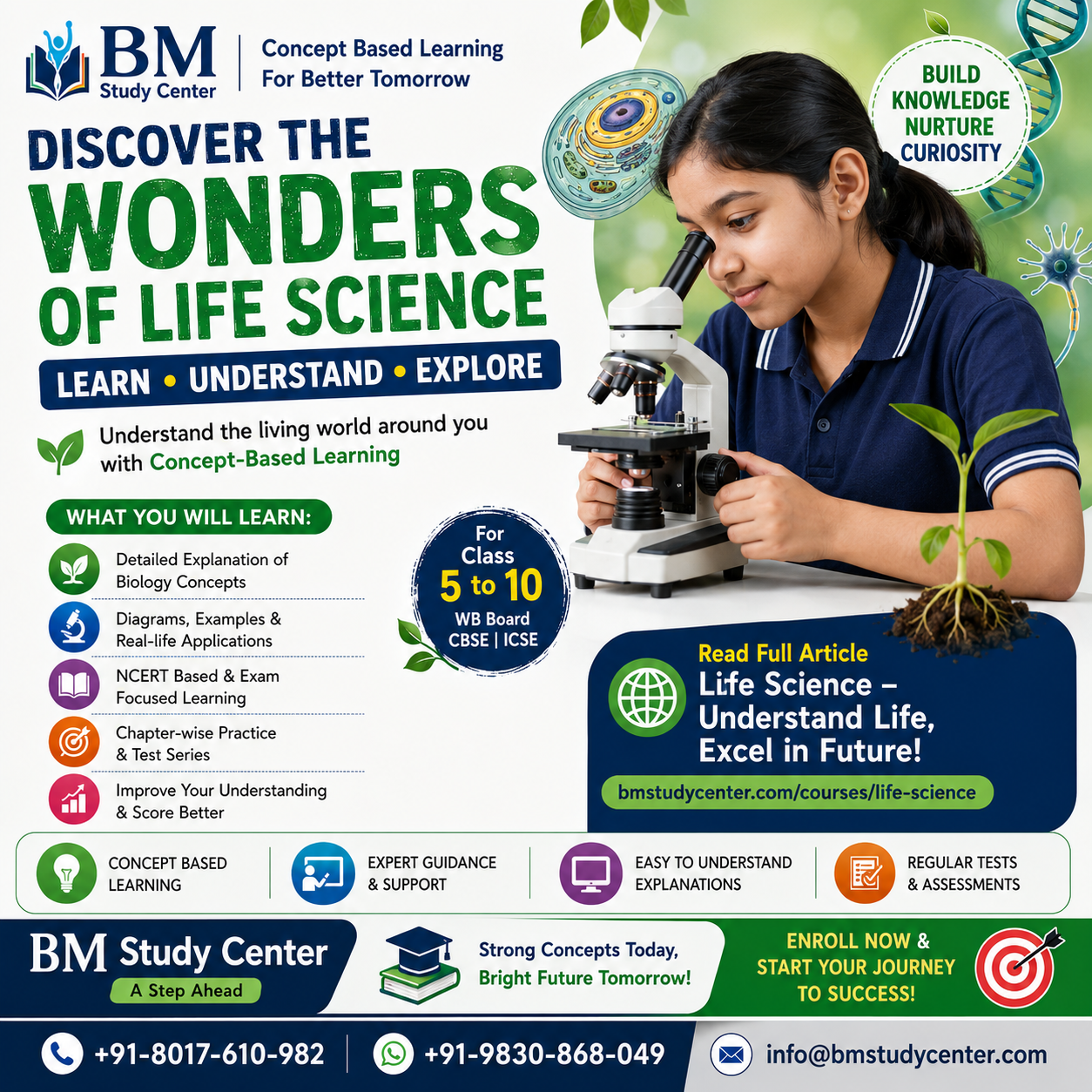
One reason students often struggle with Life Science is that it is taught as pure theory, with diagrams copied from a blackboard and terms memorised without context. That approach rarely sticks. The better way is to make biology visible: labelled charts of the human body, hands-on models of a plant cell, simple lab demonstrations, and audio-visual aids that turn an abstract process like photosynthesis or digestion into something a student can actually picture and remember. This is exactly the approach followed in the Life Science course at BM Study Center, where practical, application-based learning replaces rote memorisation.
Whichever board a student follows — WB Board, CBSE, or ICSE — the underlying biology concepts are largely the same, even if the exam pattern and depth differ slightly. What matters most is building a clear, visual understanding of living systems, from the cell to whole ecosystems, so that the same knowledge carries a student confidently from a Class 6 unit test all the way to a Class 10 board exam.
A few simple habits help at home too: encourage students to sketch and label diagrams instead of just reading them, connect topics to everyday life such as a leaf's veins or a family tree for genetics, and revise with short, regular sessions rather than one long cram before exams. Small, consistent effort across the year builds far deeper understanding than last-minute revision ever can.
If your child needs focused, small-batch guidance in Life Science or any of the other subjects taught at BM Study Center, the classes are designed around exactly this kind of practical, visual teaching. Parents can get in touch to book a free demo class and see the approach in action before enrolling.