Physics and Chemistry get a bad reputation early — long formulas, unfamiliar symbols, reactions that seem to exist only on a page. But Physical Science is really the subject that explains why a ball falls the way it does, why a mirror reflects light the way it does, and why mixing two substances sometimes produces something completely different. For students in Classes 5 to 10, that hands-on curiosity is exactly what makes the subject click, or fail to.
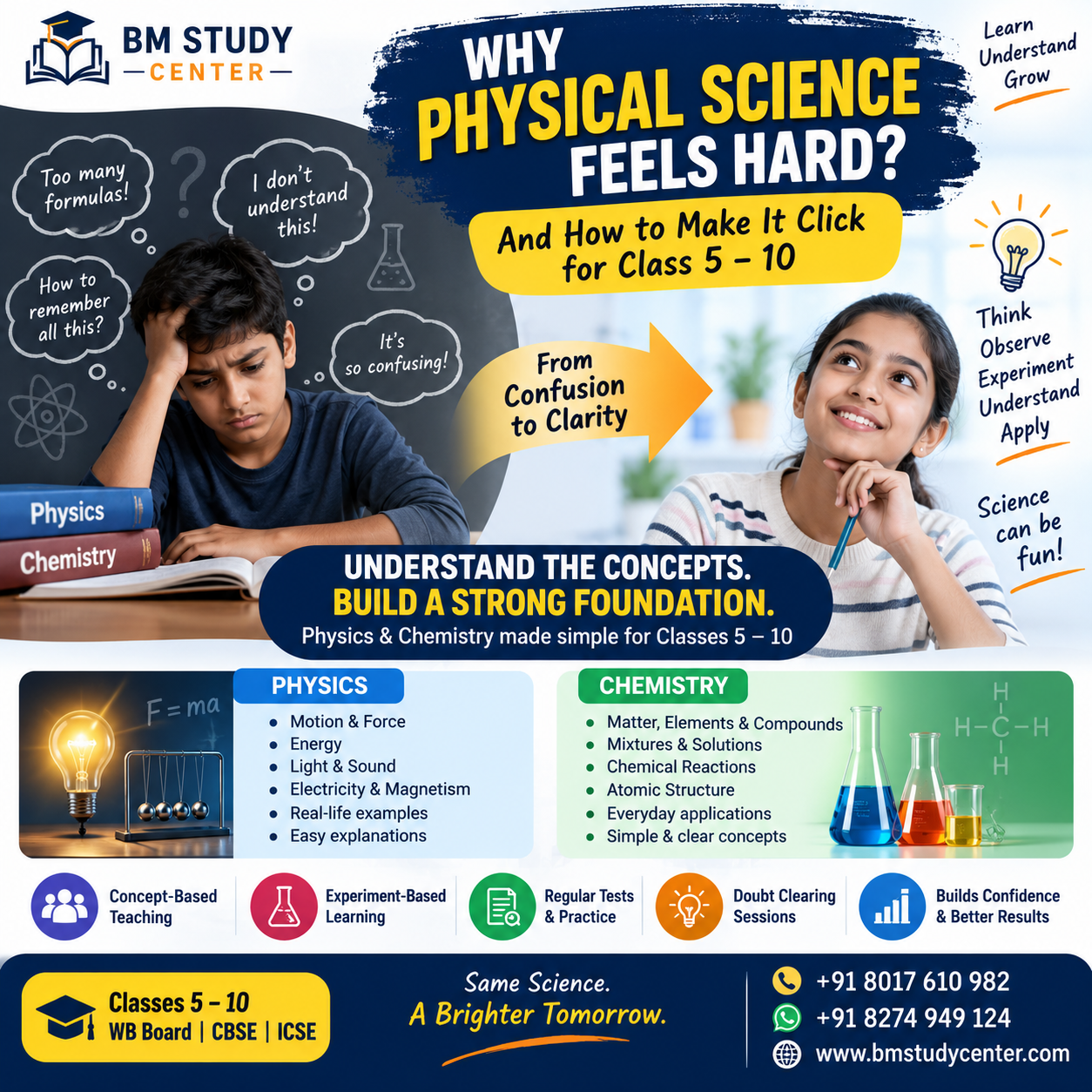
The syllabus covers two connected halves. Physics deals with motion, force, energy, light, sound, electricity, and magnetism — the physical rules the world runs on. Chemistry covers matter and its states, chemical reactions, elements, compounds, mixtures, the periodic table, and chemical bonding — how substances combine and change. Neither half is really separable from the other in how they're best taught: both reward seeing a principle in action, not just reading its definition.
This is exactly where most classroom teaching falls short. A formula for force or a chemical equation copied onto a blackboard stays abstract until a student actually watches it happen — a pendulum swinging, a simple circuit lighting a bulb, a colour change in a test tube. Hands-on experiments and demonstrations, ideally in an actual lab rather than only described in a textbook, are what turn a memorised formula into an understood concept.
That gap between reading about science and doing science is also where test performance quietly breaks down. A student who has only memorised "F = ma" can usually recall it for a direct question, but struggles the moment a problem asks them to apply it somewhere unfamiliar. A student who has actually seen force change an object's motion in a real experiment tends to recognise the same idea wherever it shows up, across different question styles and even different chapters.
This experiment-first approach — a real science lab, demonstrations alongside theory, and regular tests to check the concept actually stuck, not just the formula — is exactly how Physical Science is taught at BM Study Center, across WB Board, CBSE, and ICSE for Classes 5 to 10.
If your child needs a more hands-on way to actually understand Physics and Chemistry, explore the courses at BM Study Center or get in touch to book a free demo class.